
Porto strengthens commitment to smart mobility through real-world experimentation
Porto strengthens commitment to smart mobility through real-world experimentation
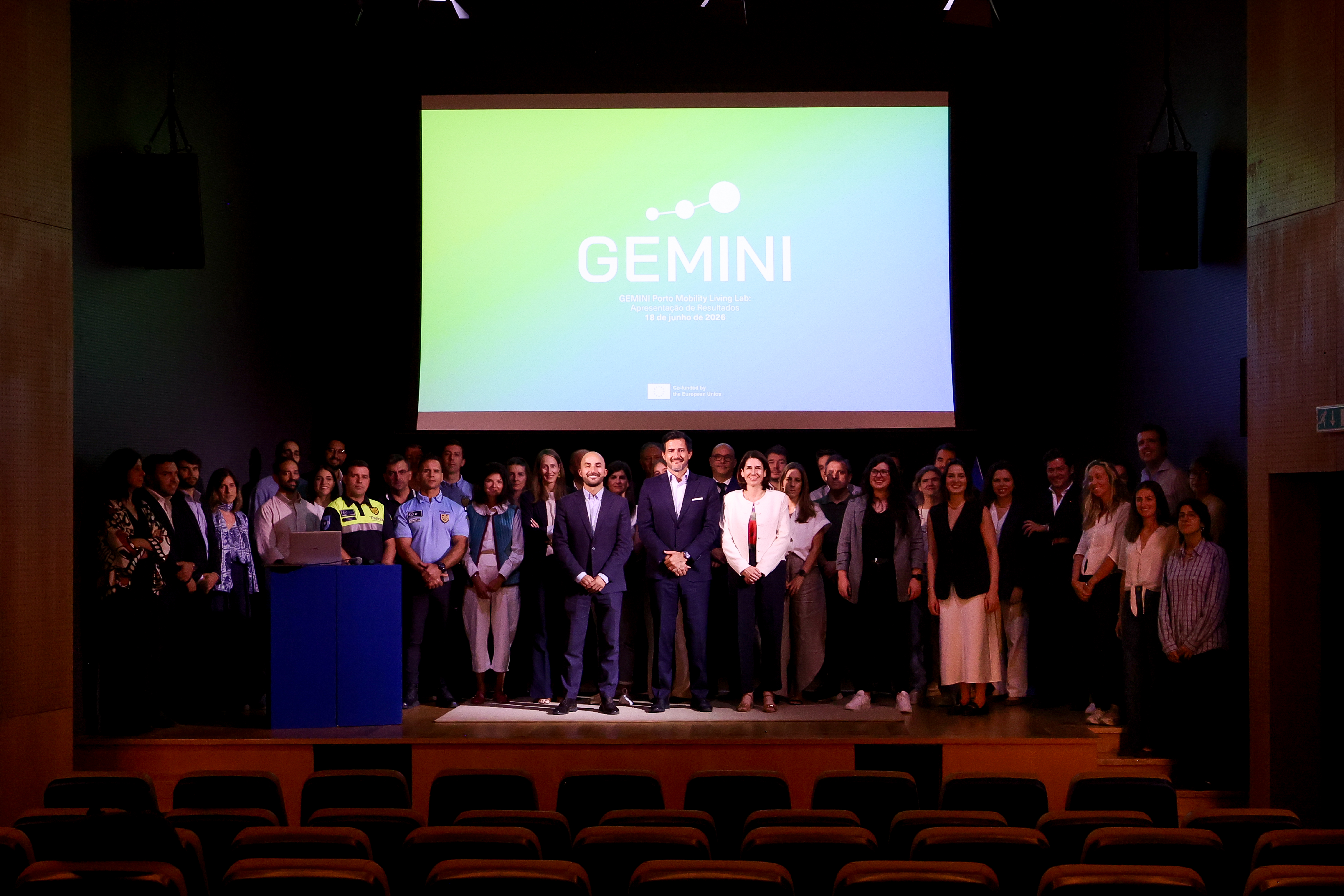
Porto has presented the results of the European project GEMINI, an initiative funded by the Horizon Europe programme that enabled the testing of innovative mobility solutions in a real operational environment and generated valuable insights to support evidence-based urban decision-making.
Locally coordinated by Porto Digital, Porto’s Living Lab brought together a broad ecosystem of public and private partners, including the Municipality of Porto, FC Porto, Via Verde, A-to-Be, the Public Security Police (PSP), Metro do Porto, STCP, CP – Comboios de Portugal, and Transportes Metropolitanos do Porto. Several municipal teams also took part, namely the Municipal Mobility Department, the Porto Carbon Neutrality Directorate, the Integrated Management Centre, the Municipal Police, and Municipal Civil Protection. This collaborative network enabled the development, testing, and validation of new mobility management solutions in a real-world setting.
By using match days at Estádio do Dragão as a testing environment, the project created the conditions to analyse mobility patterns, understand travel flows, anticipate operational constraints, and assess decision-support tools in one of the city’s most demanding scenarios.
According to Rodrigo Passos, Councillor for Sports, Youth and Associations, as well as Digital Transformation and Citizen Services, the project’s greatest value lies in its ability to test solutions in real-life conditions and translate the results into practical knowledge for urban management.
“GEMINI enabled us to test solutions in a real-world context, bringing together different organisations to address concrete urban challenges. Public innovation only delivers real value when it reaches the streets—when it supports decision-makers, operators, and the people who experience the city every day.”
The results demonstrate the potential of cooperation between organisations with diverse expertise to address urban mobility challenges. The integration of technical knowledge, operational experience, and analytical capabilities has improved the understanding of urban flows, strengthened risk anticipation, and supported more informed and effective decision-making.
According to Rodrigo Passos, one of the project’s key contributions was the creation of a more integrated and collaborative way of working.
“We tested technology, of course. But we also tested a way of working—a more integrated, better-informed approach, better equipped to respond to the complexity of urban challenges.”
For Ana Carneiro, CEO of Porto Digital, the project’s most significant legacy lies in its ability to build bridges between organisations with different areas of expertise and to transform knowledge into value for the city.
“The greatest success of this project is its people, the cooperation among local stakeholders, and the partnerships established for the future.”
With completion scheduled for november 2026, the project is now entering a capitalisation phase, during which Porto’s Living Lab will focus on sharing the results achieved and lessons learned, further strengthening knowledge transfer to other cities and partners within the European consortium.
Through GEMINI, Porto reinforces its position as a leading urban innovation laboratory, demonstrating that responsible experimentation, data-driven approaches, and institutional collaboration are essential to building a smarter, more resilient city, better prepared for future challenges.